One day in the fall of 1994, I brought Alan Lomax a lunch special from a Thai restaurant on 9th Avenue in Manhattan. This was part of my audition for the job of managing the Center for Cultural Equity, the concerningly decrepit office/archive complex Lomax presided over in a blue Hunter College building near the Lincoln Tunnel. My time in college was almost over. Preparing to move to New York, I faced a big decision: arrive with a sub-minimum wage dream job as Lomax’s office manager or take my chances on whatever opportunities might arise once I got to the city. Lomax’s outgoing assistant had just showed me a prototype of the Global Jukebox, a CD-ROM that allowed users to experience Lomax-produced audio and video clips from practically anywhere on Earth just by clicking on a map of the world - absolute cutting edge technology in 1994. Between bites of spring rolls, Lomax asked me what music I was working on. I told him that I was learning klezmer. Lomax said, “I’ve always hated klezmer music. It reminds me of Bob Wills and the Texas Playboys.”
There probably weren’t many twenty-one-year-olds walking around Manhattan at that moment who knew who Bob Wills was, but thanks to the music industry, I did. My parents were back-to-the-land-ers. Until 1978, we lived on a working bean farm in far northern Maine so deep in the wilderness that a one-horned moose would scrape his antler on the shingles under my bedroom window every morning. Our indoor entertainment options were books, a radio, a tiny black and white television that sort of picked up a couple of channels mostly in Quebecois French and a very small collection of records, which I loved. I would spend hours staring at the covers of “Sweetheart of the Rodeo” and “The Basement Tapes.” In 1974, a friend or relative who lived in a place with record stores mailed us “For The Last Time,” a double-LP Wills recorded the day before he suffered a fatal stroke. This album stayed with us when we moved to the city in 1978 and then to the suburbs in 1981. We listened to it a lot. I liked it. I still have it. I certainly didn’t know Bob Wills the way Alan Lomax knew Leadbelly or Woody Guthrie or Muddy Waters or Jelly Roll Morton, as an actual human being at the other end of a microphone, but Wills and his music had tangible and emotional presence in my life in the form of these two vinyl discs. I’m not saying Lomax’s dismissal of klezmer and Wills was a factor in my decision, but I ended up not taking the job.
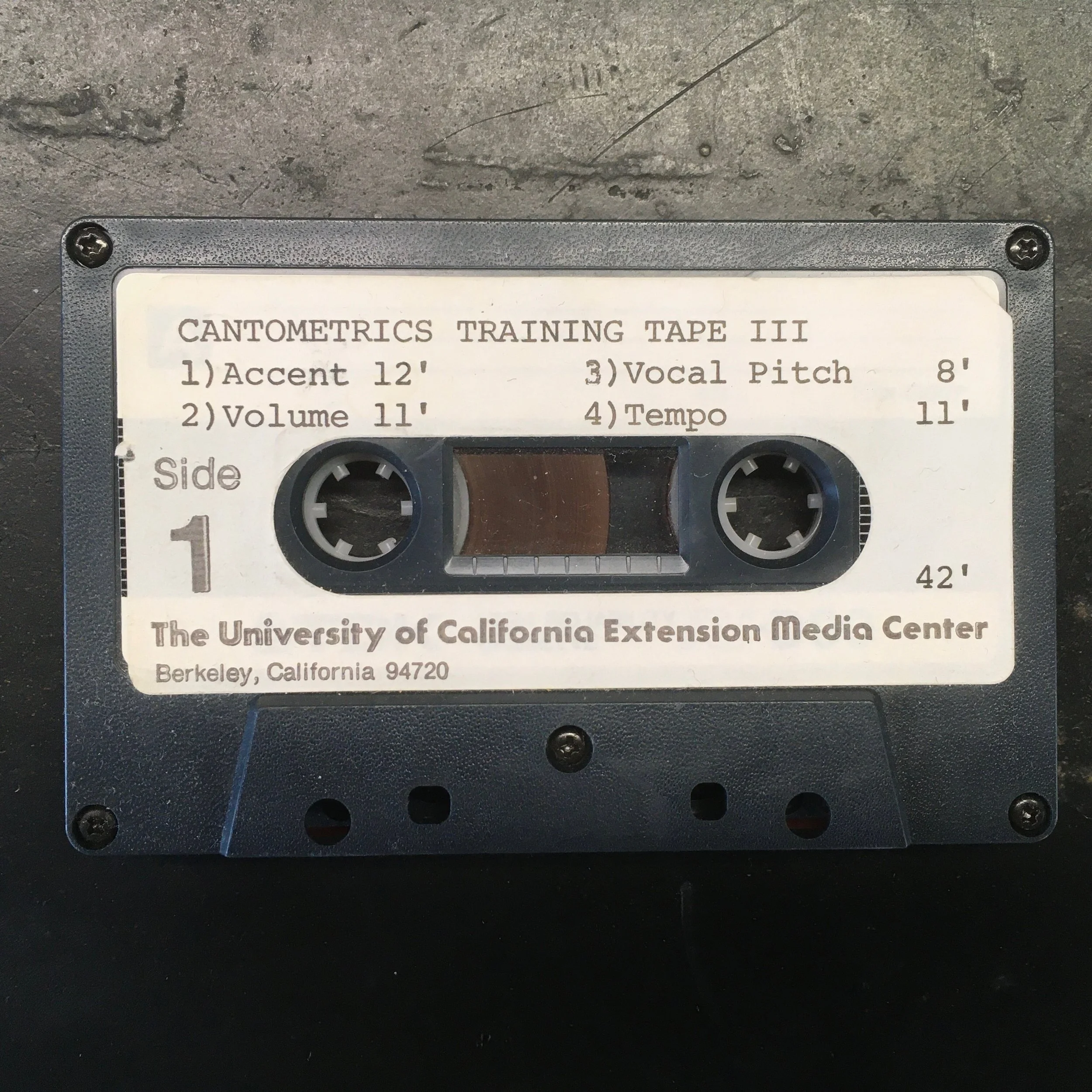
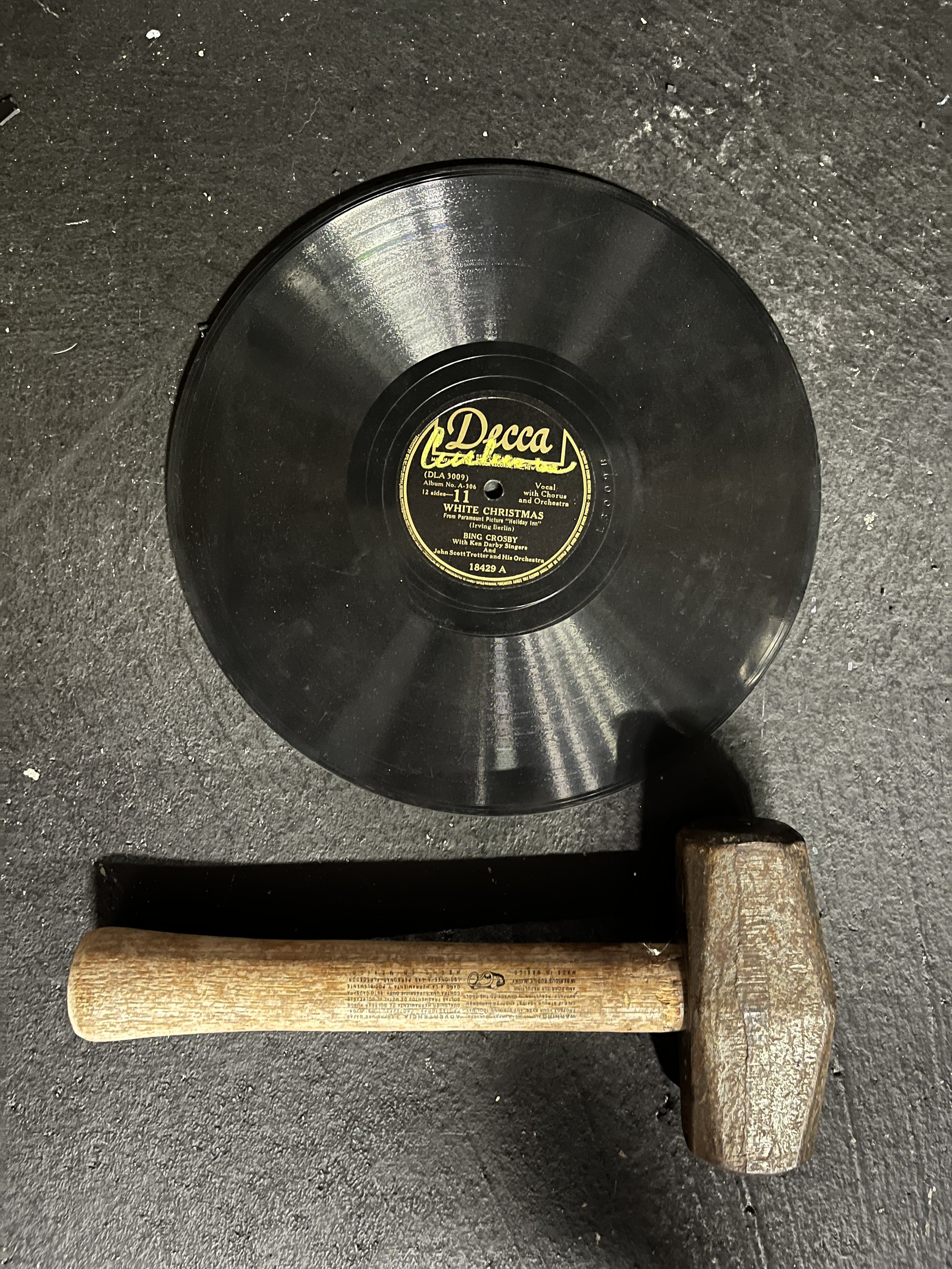
These stories and a few others about people, music and technology came to mind the other day when I was listening to a dusty 78 rpm record of Bing Crosby singing “I’m Thinking Tonight of My Blue Eyes” with Woody Herman and His Woodchoppers. It was in a pile of 78’s I bought at an estate sale about two miles from my house that included a collection of rare pre-war cantorial and klezmer records. Like most of you, I don’t listen to my LP’s or CD’s nearly as much as I used to, but I’ve been buying 78’s in bulk whenever I find them. I use them for an art project. First I record them playing on a hand-cranked victrola, then after I use my digital recordings as source material for sound pieces I smash the 78’s with a hammer, dissolve them and use them as paint. Crosby’s 1940’s records are among the most common in America’s junk stores and yard sales. He caused tons of shellac from Indian beetles to flow through record pressing plants, then vinyl, cassettes and CD’s and now immaterial digital files beamed from a data center to your phone. Even if relatively few people still listen to this music, it is well-embedded in our digital memory and well-distributed in attics and basements. I find his records all the time. Maybe there are stories behind those objects like the one behind my Bob Wills records. If so, those stories are gone. In the digital era, Bing Crosby records are just junk, destined to break into shards in a landfill somewhere, relics of a technological and cultural world that is disappearing with stunning, disorienting rapidity. Rather than sending these once-beloved records to the dumpster, I give them a final playing, a violent death, and something like reanimation as art. Ridiculous as it sounds, I think of it as a sacrifice ritual.
When I sit in front of my victrola, I listen very closely. Sometimes when I find the music dull and tedious, as I often do with Bing Crosby (sorry Bing fans), I imagine the stories behind the physical object rather than the sound contained within it. Why did someone buy this record? What did they get out of listening to it? Did they carry these records with them for decades, moving from place to place, the way my family and I carried our Bob Wills records? Sometimes there are clues, like the surface wear on the copy of “White Christmas” I smashed a few days ago. Going by the evidence of the other records in their collection, this family was Jewish, but they listened to this one more than any other in the pile. Did they play it for Christmas dinners like the ones my Jewish grandparents would have?

Listening to “I’m Thinking Tonight of My Blue Eyes” was a little bit different from “White Christmas,” because it resembled music I like. Instead of recording with a “sweet” band like the Waldorf-Astoria Orchestra, Crosby made it with Woody Herman and a small band, a “hot” band, a jazz band. They had the rhythmic propulsion and looseness of jazz, obviously improvised arrangement elements like instrumental commentary and a trumpet solo, even a shout chorus. But something was off. The underlying material of the song had the relatively simple melody and harmony of country music, not the Tin Pan Alley-style writing that these players thrived on. Bing’s singing and the Woodchoppers’ playing had a lazy, sarcastic quality, as if they thought the song was “corny.” I always hear that word in saxophonist/composer Benny Golson’s voice, which is fitting, since it was musicians like Golson who a generation later defined its opposite, “hip,” by writing and playing things that swerved in unexpected directions, had surprising rhythmic inflections or incorporated notes outside basic tonal harmony. A “serious” musician or listener would find those gestures interesting because they bend or break the pro-forma patterns of the “corny” pop song form exemplified by middle-of-the-road artists like Bing Crosby. Though Crosby and Herman accomplished some degree of hipness on other recording dates, on this one they failed.
Still, the song seemed familiar. I couldn’t place where I had heard it before. Before I smashed it, I looked a little closer at the record label and noticed that the song was credited to A.P. Carter, paterfamilias of the Carter Family. I could have gone down to my own basement and dug around for my Carter Family CD’s, but instead I played their recording via YouTube. Even after the chain of grainy digital conversions and compressions that allowed their song to emerge from my speakers, the Carter Family hits hard. This is the sound of people with total confidence in themselves and each other and a direct connection to the song they're singing, like they were doing this long before anyone tried to make a buck off of their music by getting it to come out of a machine.
As I listened again to Crosby’s record, it occurred to me that the difference between the Carter Family in Victor’s Camden, New Jersey studio in 1929 and Bing Crosby traipsing into an LA studio thirteen years later with Woody Herman and his Woodchoppers, some sketchy charts and a patronizing attitude, is what Lomax was talking about in his klezmer/Wills analogy. Lomax was trying to document people like the Carters who exemplified the human phenomenon of music that existed before you could pay a few cents for a 78, wind up the victrola and hear professionals, even celebrities, sing a song that reminded you of days gone by. Crosby and Herman’s nonchalant professionalism is the sound of workers making a product for someone else's profit. Capitalism may have influenced the music of the Carter Family, but it produced the music of Bing Crosby.
Before we get too caught up in an argument about authenticity or originality or whatever, I should note that cursory internet research reveals that Carter based “I’m Thinking Tonight of My Blue Eyes” on “The Prisoner’s Song,” a song with a blurry history recorded in 1924 by conservatory-trained faux-hillbilly singer Vernon Dalhart. Wikipedia claims that over a million copies of both Dalhart’s record and the song’s sheet music were manufactured in the 1920’s. The Carter Family probably learned this song through the heavy mediation of the then-new music industry, not from some ancestral source. Nevertheless, even filtered through all of these layers of technology and business their singing and playing transcends economics. As Sun Records owner Sam Phillips supposedly once said to Atlantic Records producer Jerry Wexler about another recording session, it “doesn’t sound paid for.”
Though maybe not explicitly anti-capitalist, Lomax’s idea of cultural equity was in opposition to, or at least positioned as an alternative to, a global culture industry flooding the world with products like Vernon Dalhart and Bing Crosby records. In this 1972 manifesto posted on his organization’s website, Lomax used the language of the then-new environmental movement to articulate this crisis:
A grey-out is in progress which, if it continues unchecked, will fill our human skies with smog of the phony and cut the families of men off from a vision of their own cultural constellations. A mismanaged, over-centralized electronic communication system is imposing a few standardized, mass-produced, and cheapened cultures everywhere.
To Lomax, Bing Crosby and Woody Herman applying jazz chops to the Carter Family’s adapted song is an obvious example of that “smog of the phony.” From there it’s easy to draw a line to Bob Wills, another famous white bandleader working in a different style but also making music rooted in, or maybe it’s more accurate to say based on jazz. In a way, Crosby and Herman’s jazz-approximate adaptation of Carter’s song is the inverse of Wills’s Texas-ized adaptation of jazz. Crosby and Herman approach country music from jazz, and Wills approaches jazz from country music. If you subbed fiddles and guitars for the brass and winds on the Bing session, you’d have a sound pretty close to western swing. If one were feeling uncharitable, it might be fair to question how accurately the term “swing” applies to either band. Either way, by Lomax’s standards, mixing jazz with Southern string band music for the purposes of mass-produced entertainment is an example of how the capitalist system pollutes human culture for profit.
Which makes drawing the next line, the one Lomax drew from Wills to klezmer music, a little painful. If klezmer reminded Lomax of Bob Wills, who “cheapened” Texas fiddle music when he took it out of the realm of hyperlocal “rawness” and hybridized it with big city commercial swing, was he saying that klezmer music is a similar cosmopolitan concatenation? Is there something about klezmer music that intertwines it with capitalism, or more generally, money? Is it too urban? Too much a hodgepodge of other musics picked up while wandering the world? Inauthentic? Rootless? It’s tempting to say, “let’s not go there,” but go there I did, quite materially. A few months after my day with Lomax, I would be a working professional musician, playing concerts and weddings and bar mitzvahs and holiday parties in a klezmer band. Which is awkward, because even if Lomax did walk right up to the line of in your face (in my face anyway) antisemitism in our conversation, it is true that my experience of klezmer music, and pretty much all of the music I have been involved with as maker, listener, collector, etc., has been an experience of capitalism. I can’t deny that my motivations for playing klezmer music were partially financial. It enabled me to become a “professional musician,” and resolve at least temporarily the questions dogging me when I was in Lomax’s office plotting my move to New York.
Lomax might say that’s exactly the problem. Like all young musicians growing up in the late 20th century, being like the Carter family wasn’t in the cards for me. Music was almost always wrapped up in some version of capitalism and its close cousin, technology. Even when my friends and I were playing in garage bands just for the fun of it after school, we learned those songs from records someone bought, coveted instruments we saw in magazine ads and made moves we copied from bands we saw on MTV. I wanted to be like the guys in the Texas Playboys or the Woodchoppers, playing gigs and recording sessions for money. What Lomax sought in music was something outside of that model, something older. He might use words like “raw” or “pure,” words with overtones that ring a little differently to me today than they did in 1994. What would an authentic “cultural constellation” even be for a person like me, a child of secular Jewish ex-hippies moving from far Northern Maine to the Boston suburbs with a twelve inch black and white TV and a box of records? In Maine they used to say, “If my cat has kittens in the oven, that doesn’t make them muffins.”
Fortunately for all of us living in the age of “over-centralized electronic communication,” Lomax was out there gathering evidence of the vast wealth of human expression, as separate from the corrupting influence of capitalism as possible - at least until he could finagle a record deal to release it. He hoped that putting his recordings onto albums that would go out into stores next to Bing Crosby and Bob Wills, and then onto digital platforms like the Global Jukebox would spur a vast multicultural renaissance, like the American and British folk revivals he helped inspire. Maybe in the 90’s when kids like me were digging through record stores that had overflowing “world music” sections stocked with reissues of Lomax’s recordings, it might have seemed like this vision was coming true. Unfortunately for music, that’s not what happened. Now the “one way” communication is a micro-targeted interaction between a user and a faraway computer – at best an algorithmically powered retrieval of a low resolution audio file with maybe a few fragments of a penny paid to whoever owns its intellectual property, and at worst an AI-created mashup of elements derived from those files. After a little over a hundred years of singing into machines, the machines sing back to us.