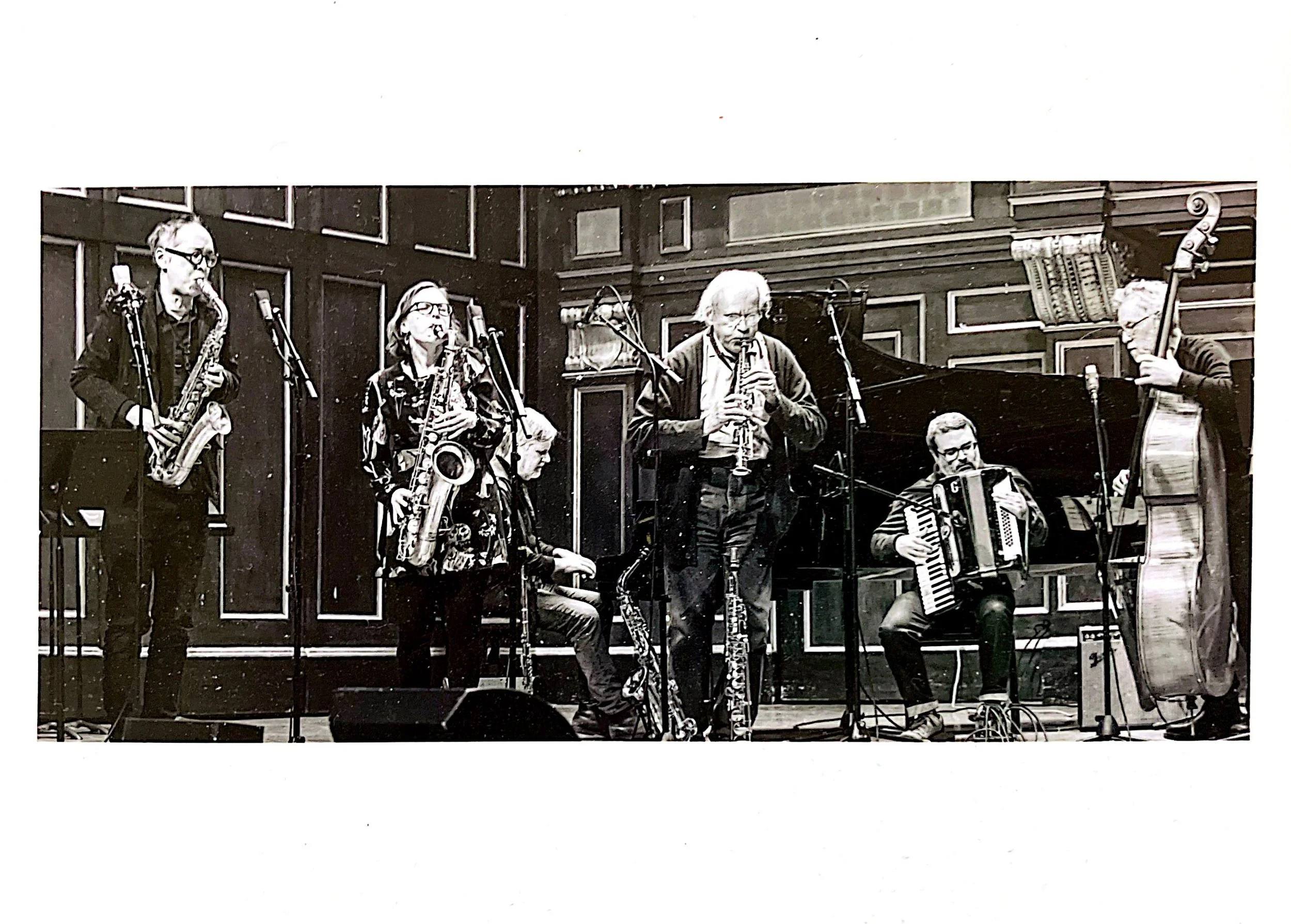
Prelude - Dream Work
To teach is to be in the middle. We are the nexus between the past—our teachers—and the future—our students. We mind the boundary between ambition and career. We are guides through the area between childhood and adulthood. We represent many other forms of middleness: mid-career, middle-age, medium. In cases of embodied knowledge, or practice, like in medicine, sports, and the arts, we experience middleness in cycles over time as we work alongside our students, collaborating, to use a contemporary word. We have an often-uncomfortable status in institutions which are in another kind of cycle. The administration of a university works to perpetuate the institution through the turbulence of the marketplace, looking capitalism in the eye year after year. The faculty, in theory at least, turn our attention towards other things. We are responsible to our disciplines, which we inherit from our teachers and convey to our students. In so doing, we are stuck in the middle between the “real world” of the administration and the aspirational zone in which some lucky students are told, “follow your dream.” The “dream” my conservatory students, colleagues and I follow is music. We are in the middle of that so-called dream while we do our work, our “real” jobs.
I can’t speak for any other music faculty, but for me, writing in the spring of 2026, this tension between “dream” and “real” has been particularly acute. I experienced it in a very direct, if typically middle, way. On one side were the overlapping crises that show up at school every day in forms like dramatic changes in our students’ relationships to and knowledge of music, the relentless omnidirectional push of AI and other technologies, and the increasingly tragic encroachment of natural disasters, socioeconomic instability and war, pulsing through our devices and brains at the speed of glitchy campus wifi. On the other side was Anthony Braxton, the teacher who started me on the journey towards this precarious position. We spent three days together at the conservatory, forcing me into an all-encompassing IRL encounter with my own middleness.
Root Guru - April, 1991/October, 1992
I am in the admissions office at Wesleyan University in Middletown Connecticut, reading a printout of that day’s schedule of classes. I see “Music 387: Materials and Principles of Jazz Improvisation – Prof. Braxton, A” and I feel an electrical charge flow from my head to my feet.
I don’t know Braxton’s music very well, but I know his name because I am a teenage music nerd who has spent every Saturday for four years learning jazz piano at the New England Conservatory Preparatory School, listening to Sun Ra, Captain Beefheart and John Zorn in NEC’s record library and digging through the bins of Boston’s many record stores. Despite already committing to attend Wesleyan, until this moment I have been unaware that Braxton taught there. For the first time, I rush to the brutalist concrete blocks of the Wesleyan Center for the Arts and descend to the bunker-like basement room with slanted pegboard walls (it had been designed as a recording studio) where Prof. Braxton, A teaches. He is not there.
Eighteen months later I am in a lecture hall at Wesleyan, attending Prof. Jan Willis’s Buddhism class. Dr. Willis is saying that in Tibetan Buddhism, the Tsawe-Lama or “root guru” is a single teacher so profound that on first meeting them, or even just reading their name in a book, the student will feel an electrical charge flow through their body.
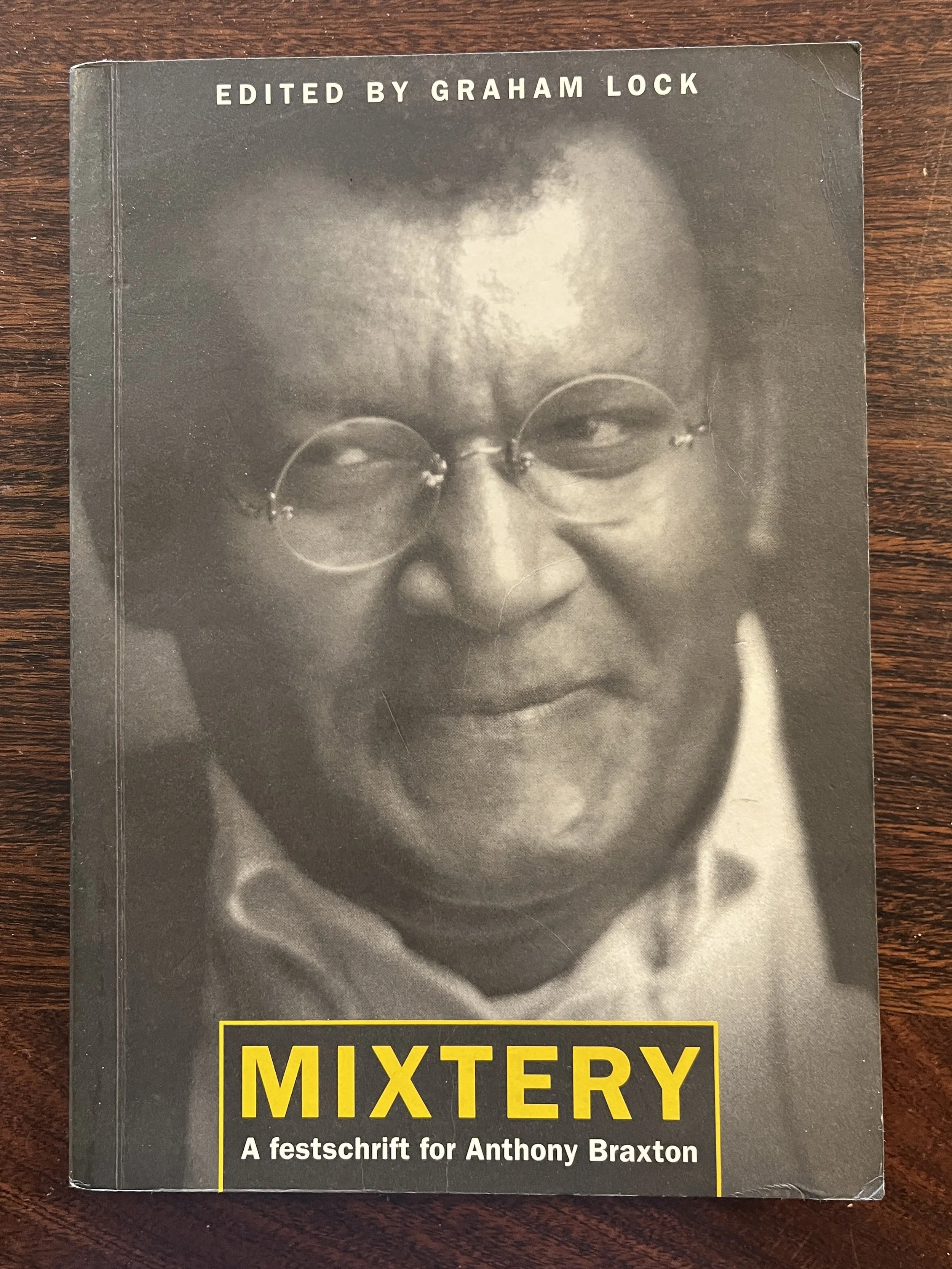
First Draft - 1995
I have written parts of this story a few times before. The first time, I was twenty one years old, close to the beginning.
I walked into the first meeting of Music 387 in the fall of 1991 as a semi-competent 18-year-old jazz pianist. I’d been at college for about four days and was completely blown away. It was my first time away from home, and I was totally adrift in a new world of people and experiences. It was a state of mind particularly appropriate for the discovery of a new music, really a new way of looking at life, something I would achieve by studying with Anthony Braxton.
I had heard some of Braxton’s records and knew his reputation as a sort of a maverick (actually, Barry Shapiro, my piano teacher from high school had said, in a respectful way, mind you, that he was totally crazy), but had no idea what went on in his classes. I’d spoken to him a few days earlier, briefly explaining that I’d played piano for about ten years, studied blues and bebop, etc. Braxton was in a hurry. He thanked me for my interest in taking his class, welcomed me to Wesleyan, and disappeared back into his mysterious office, leaving me completely jarred. No audition? He doesn’t even want to hear me play? Who is this guy anyway?
So I went to Olin Library and pulled out a few Braxton records. The first one was the box-set of quartet concerts in England, from the tour that became the basis for Forces in Motion. As the music flowed and blasted, and as I read Graham Lock’s liner notes, I felt something happening. I was hearing something that I had never realized could really exist. That music, those sounds were like something out of my dreams.
I wrote that for the book pictured above, Mixtery, which was published in honor of my teacher Anthony Braxton’s fiftieth birthday.
The Future of the Universe - September, 1991
It is my first week of college. I am back in the oddly shaped underground bunker-like classroom, unsure what to expect. A handful of students - there couldn’t be more than seven or eight of us - are waiting for Prof. Braxton A. He appears, in his trademark cardigan, talking a mile a minute in what seems like self-made jargon, throwing around words like “restructuralist,” “vibrational” and “tricentric.” He asks, “People, do any of you know the work of the American master Eugene Chadbourne?” I raise my hand. Of course I know Chadbourne from his work with Zorn and from a few solo records and cassettes I picked up in my music store peregrinations. LSDC&W was a favorite. I am the only one in the class who knows him. Braxton seems impressed. After talking for what feels like a very long, confusing time, he asks us what instruments we play. I am one of four pianists. “I can take three pianists, but not four,” he says, furrowing his brow, “One of you must have another instrument.” I raise my hand again, a little more sheepishly this time and say, “Sir, I have an accordion.” Braxton walks over to me, grabs my arm, drags me into the weirdly angled corner of the room, puts his face right up close to mine and whispers, “The future of the universe depends on you playing accordion in my ensemble.”
Interlude 1 - Higher Education A
Looking at that story in 2026 is to see an educational scenario completely divorced from the neoliberal values that run through higher education today. In the 90’s, whether or not this was true, an elite liberal arts college like Wesleyan presented itself as a place where a diverse student body studied a diverse range of subjects for the sake of learning itself. Careerism was part of the equation for sure, but it was not the sum total of the college experience. As part of that commitment, at least since the 1960’s, some wealthy colleges like Wesleyan used their institutional sturdiness to perpetuate and support prestigious if not financially successful artists like Braxton, giving them enough stability to support families and do their work at a slight remove from the culture industry and giving (or maybe more accurately, selling) students like me access to them. In 1991, many musical radicals of Braxton’s generation including electronic composer Richard Teitelbaum and composer/trumpeter Wadada Leo Smith (both then at Bard College), saxophonist/composer Roscoe Mitchell (then at the University of Wisconsin), and composer/theorist/trombonist George Lewis (then and now at Columbia), were taking academic jobs. I remember Derek Bailey marveling to me over tea in his East London kitchen a few years later (more about that in a second) that so many of his American friends had gone into academia. “Even Leo!” he said. From the European perspective, giving up the freedom of full-time life on the musical edge seemed bizarre. I had to remind Bailey that in America in those pre-Obamacare days, there was no other way to get decent health insurance, especially for a family, than to get a “real job.” At that time, Braxton had three young children. I’m sure his hiring process did not involve a curriculum vitae, recommendation letters and a diversity statement.
Here in America, at this moment, from the perspective of administrators of schools like the ones where I teach, colleges and universities are large institutions teetering on the edge of a multitude of disasters: demographic decline of the college-aged population, the end of federal funding, the capricious priorities of the donor class, dwindling international students, and all the rest. The recent news that Hampshire College, a school perhaps more extreme than Wesleyan in its academic looseness but also a home for avant-gardes of many kinds, is shutting down only makes this reality more immediate. Whatever colleges are looking for in faculty today, I’m pretty sure they do not want maverick visionaries who are going to tell an 18-year-old in his first week of undergraduate studies that the universe depends on him playing accordion. In fact, as a parent of a teenager who is not so many years away from college, in this time of polycrisis I would not want a stranger imbued with so much authority encouraging my child to do something so patently ridiculous at such an impressionable age. Higher education’s purpose may be to help launch a young person into a future career, but not like that! The strange thing is, I didn’t show up at Wesleyan in 1991 thinking my job was going to be “professional avant-garde accordion player,” and yet, thanks to Prof. Braxton A that is exactly what happened.
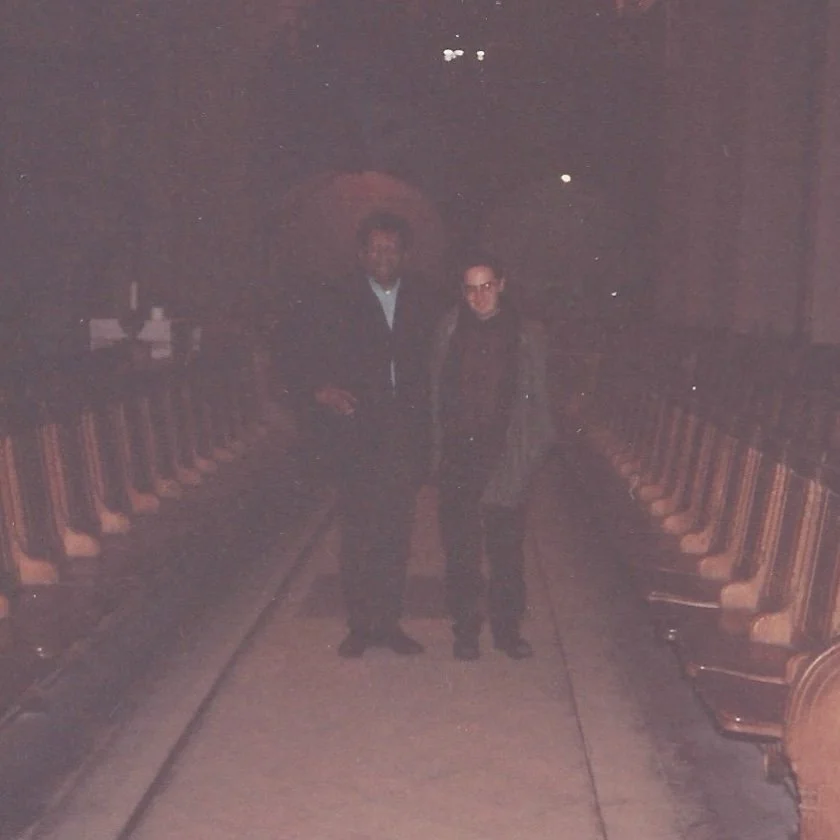
In the Thomaskirche
Leipzig - December, 1993
I am walking out on stage with Anthony Braxton at the Leipzig Gewandhaus, one of Germany’s major concert halls. It’s been an eventful day. It started before dawn in London, where I have been in a semester abroad program since September. This has mostly meant pretending to study Shakespeare and spending as much time as possible playing free improvised music. Thanks to introductions from Braxton, I have gotten to meet and play with Steve Beresford, Lol Coxhill, the aforementioned Derek Bailey and even played a couple of gigs with visiting Americans like Eugene Chadbourne and Jimmy Carl Black of the Mothers of Invention, who were then touring Europe as a duo. It has been going well.
One day, out of the blue, the communal dorm phone rang and it was Braxton, asking me to come to Leipzig and play a duo concert with him. This was not the first time Braxton hired me for professional work. We had already recorded 4 (Ensemble) Compositions 1992 for Black Saint records, which unfolded over three dream-like days in Manhattan when I met and got to play with heroes like Guy Klucevsek, Amina Claudine Myers, Don Byron and so many others. But that is another story. This concert in Leipzig is just the two of us. We haven’t played together in months, and never as a duo outside of lessons in his concrete bunker office.
The morning of the concert, I packed my accordion into a huge cardboard box padded with styrofoam peanuts and somehow got it to Heathrow airport. I arrived in Leipzig, picked it up at baggage claim, took it out of the box and realized it was broken. A madcap pursuit of an accordion technician ensued, ultimately involving a taxi ride to a hut in the middle of a field way outside of town, where a man with a huge beard opened my accordion and fixed it in a matter of seconds. I got back in time to go with Braxton to the Thomaskirche, the church where Bach worked for the last twenty seven years of his life, writing cantatas every week. Braxton was incredibly moved – Bach was one of his greatest heroes. Later at soundcheck, which would also be the only rehearsal for the concert, I played piano so aggressively that I cut two of my fingers on their immaculate Hamburg Steinway. The piano tuner looked on in horror. “There is blood on the keys!” he said incredulously, in thickly accented English.
The concert is starting – I am shaking with fear. Braxton gestures downwards with his alto saxophone, cuing the first note. We start with Composition 40(O). I try to stay with him as he pushes the piece away from the written melody into an open improvisational space, first by keeping the piece’s off-kilter rhythm intact but choosing different notes, then by morphing his sound and phrasing until we find ourselves doing something completely different. The electricity of Braxton’s sound transforms my fear into energy. I trust it and follow it.
The next morning, I will wake up and find that in the course of my trip to the accordion repair man’s hut, I managed to lose the paper plane ticket for my return flight to London. Braxton will say goodbye at the train station. His quartet with Marilyn Crispell, Mark Dresser and Gerry Hemingway has a gig in Vienna. The German concert promoter will shake my injured hand and disappear. I will be on my own.
Interlude 2 - Tricentric Methodology
Braxton composes using a system that bears resemblance to traditional notation, so it’s possible to look at a Braxton score and “read it down” in the ways that classically trained musicians or jazz players know. This could be considered correct, but it is not what Braxton would do in his own ensembles. Like most improvising composers, he expects players to interpret his scores in ways that go far beyond written information. He does this on paper by using a personal notation system involving graphic score techniques (abstract images on the page) and other unconventional notation, but he also does it in live performance by guiding and conducting players using cues and hand symbols, and by providing a central gravitational force with his own authoritative, disruptive playing.
On the structural level, Braxton long ago broke down the concept of the musical composition as a discrete entity with all of the information needed to play it encoded onto the page. In Braxton’s thinking, all of his compositions can be played on top of each other, at the same time, by any instrument - regardless of what instrumentation it was originally written for. Since the mid-90’s, in a Braxton performance, the full ensemble starts playing one main composition, often written especially for that gig, but they will also have a set of other compositions or parts of compositions which they can deploy while the main piece is still going, either alone or with other members of the ensemble, spontaneously or pre-planned. In the 2000’s he took this idea to such an extreme that he provided his ensembles iPods with his entire discography on them, allowing the musicians to trigger tracks from his albums on top of the live performance. Improvisation is also an important part of the equation, either alone or in duos, trios or other small groupings. Each member of the group is expected to do all of these things at different times: read the main piece including all the graphic notation, improvise, and play the sub pieces, alone or with others. These three roles represent the “threeness” of the Tricentric concept of performance: composition, improvisation and something undefined in between those two poles.
There are many ways to achieve that third zone: having an instrumentalist sight read a part that is impossible for them to play, a piccolo playing an organ part for example; the use of unconventional notation like the “diamond clef,” indicating that the staff can be interpreted as any clef, any transposition, taking advantage of the way that the note a viola player reads as middle C in the alto clef would be read by a violinist as a B natural eleven semitones above that in the treble clef; a system of simple shapes (circles, squares and triangles) used throughout the score as cues, or portals in and out of the main piece into improvisation or a sub-composition. If all that sounds confusing, then you’re starting to understand. Braxton is trying to confuse players, to destabilize their “normal” ways of interpreting written music and bring them into his Tricentric mindset.
This is why Braxton’s music sounds so different when his ensembles play it rather than conservatory trained new music ensembles or jazz bands, and maybe partially why ever since the 90’s he has tended to work with people like me, students who he has specifically trained to understand his system. We might or might not have the kind of chops that would qualify us for one of those other kinds of ensembles, but what we do have is the confidence to reach for that unknown middle territory, to take the risks that Braxton wants in his music without the dogged insistence on “correctness” that we usually see in musicians who strive for accurate interpretation of notation 100% of the time. As he often said in rehearsals, “If you’re not making mistakes, you’re making the biggest mistake of all.”
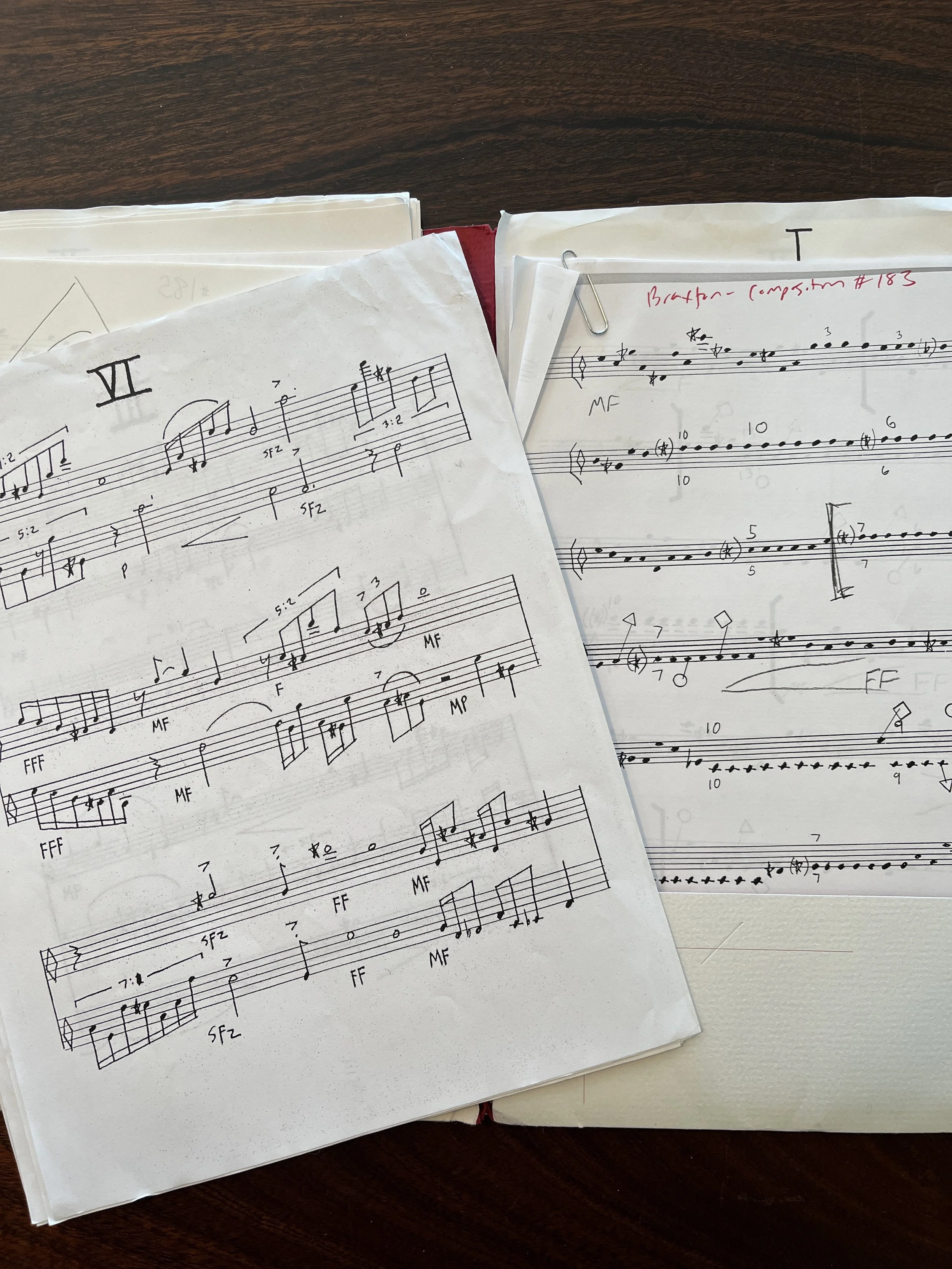
Charts from the first Ghost Trance session.
Ghost Trance 1 - August, 1995
Percussionist Kevin Norton parks his Volvo wagon in the parking lot next to the CFA concrete box. Early that morning we met at the Washington Heights side of the George Washington Bridge and we drove up to Middletown together to do a recording session with Braxton and bassist Joe Fonda. I had been meeting Kevin at the GW Bridge for a few months. He would pick me up and drive us back to his house just on the other side of the bridge in New Jersey and we would practice Braxton tunes together. Kevin was also teaching me Klezmer music – soon we would be touring with both Braxton’s bands and David Krakauer’s Klezmer Madness. We assumed that the new Braxton quartet would be somewhat like the previous one with Crispell, Dresser and Hemingway. We were wrong.
I knock on the glass door to Braxton’s office. He isn’t there. I go across the lawn to another concrete box that houses the music department offices. I hear the photocopier humming away. There is Braxton, surrounded by piles of paper. He is copying what seems like hundreds of pages of music. He had stayed up all night writing four epic new compositions. I look them over as I help him sort them into four stacks. They are nothing like the pieces Kevin and I had been practicing. Instead of the complicated polyrhythms and angular melodies we had worked on, these pieces consist of page after page of un-beamed note heads interspersed with graphic symbols. I recognize those symbols from some of his earlier pieces, but the endless stream of dots was new. It almost looks like minimalism (see pic above).
We set up to record in the same triangular-walled bunker room he used for class. “This is Ghost Trance Music,” he says, muttering something about a course he had been taking on Native American spirituality, but I am too confused to remember it exactly. We start rehearsing, sight reading the extremely long pieces, stopping to add extra notation like brackets indicating repeated sections, assigning certain of those repeated phrases as backgrounds for solo and duo improvisations, and glancing at a few short pieces that looked more like his earlier compositions, which he intended us to play on top of this main piece. The rhythmic feel is strange – more consistent than the constantly shifting web of odd time signatures he had been using in the recent past, but relentlessly straight. I ask if it could go into something that feels more like a groove or swing - an idea that Braxton quickly dismisses. He wants a dry, on top of the beat feel rhythmically close to the Native American music he had been studying. We record four pieces that would become the CD Four Compositions (Quartet) 1995, the first version of what would be his main compositional language for the rest of his career.
Trillium R - October, 1996
I am on the West Side of Manhattan at the John Jay College of Criminal Law’s Gerald Lynch Theater. For months, I have been working behind the scenes with Braxton and my fellow board members of his Tricentric Foundation on the world premiere of Braxton’s four-hour-long, fully staged science fiction opera Trillium R – Shala Fears for the Poor. The second and final performance is over. The audience, which was not nearly large enough to cover the budget of this DIY production, is gone. The full-size orchestra of hardcore Braxtonians and New York freelancers is packing up. The giant puppets, built by a friend from arts camp I recruited, are lying on their sides as we figure out where they will be stored. The singers I hired are getting ready to leave. At least one of them is extremely angry at me – rightfully – because I was not straightforward with her about how much she was going to be paid. Braxton is also extremely angry at me. I am not sure I understand why.
Iridium (Ghost Trance 2)/Tonic - March, 2006/July, 2003
I am at a jazz club near Times Square, listening to the Anthony Braxton 12+1tet, sitting at a two top with a prominent music critic, who is enjoying both his dinner and the music. Some of the audience members, like poet Nathanial Mackey, have traveled long distances to attend. Later, in a poem, Mackey would frame his trip to Iridium this way, “…Pilgrim someone called me. I said no/then I said yes.” Other travelers’ presences seem less intentional. This is a tourist spot, and many of the people of the room are clearly dissatisfied to be listening to Ghost Trance Music instead of straight-ahead jazz, the kind of music this venue usually books. Though my trip was just a subway ride from Brooklyn, I too feel a bit like a pilgrim traveling to the source of something – not exactly faith, but I can’t deny the religious overtones of my journey to midtown. The root guru inducted me into his order, then he cast me out. I have returned if not for an audience, then to be in the audience.
This is only the second time I have been in the same room with Braxton since my excommunication. The first was in 2003, at a packed duo gig with Wadada Leo Smith at Tonic, a club I was involved in starting in a former kosher winery on the Lower East Side. Until this gig, I stayed away when Braxton was playing in New York, but the opportunity to hear Braxton improvise with one of his original comrades from the AACM in a tourist-free club where I was very much on home turf was too tempting. He and Smith emerged in a cloud of weed smoke from the basement room where the giant old wine casks had been repurposed into musky-scented booths. Braxton brushed by me as he walked to the stage through the dense crowd but didn’t notice me. I remember the gig as electrifying – the two peers pushing each other in ways that their performances with younger people didn’t seem to access. There was no politeness, no clear hierarchy like soloist and accompanist, just two powerful voices intertwined, confronting each other and their shared histories in real time. It would be released as a CD. When I listen to it now, it doesn’t quite sound the way I remember it – it’s more spacious than aggressive, more structural than exuberant. At the time, hearing Braxton playing again in what felt like such strong form was a jolting reminder of how much he and his music meant to me, even if he no longer called me for gigs.
Back to 2006. After the cataclysm of Trillum R, Braxton has built a new community of players around him, many of whom, like Taylor Ho Bynum (who I had known since we played jam sessions in a Brookline ice cream parlor when he was 14 and I was 17), Steve Lehman and Mary Halvorson, are former Wesleyan students. Now they are starting to show up in New York, and from what I hear when I run into them at gigs and parties, it is clear that I am persona non grata in this community. I am curious enough about this new generation that I again break my not exactly self-imposed exile to hear the band at Iridium.
In his poem Ghost of a Trance – “mu” sixty-first part Mackey describes the gig this way:
It was a ghost of a trance. I was a
guest of the trance. What went on we
blamed on the ghost... It was the
ghost of a trance, each of us a
guest
of the trance. No two times were the
same...
When we hit a wrong note we said
nothing. When we hit the right note
we said so what...
In the Tricentric system, the diamond clef and the tendency for parts to be assigned to instruments other than the ones for which they are originally written make pitch relative. As Mackey perceived, this means that in terms of pitch there is no distinction between right and wrong – no punishment for wrongness and no reward for rightness. Intervallic directionality, rhythmic density, tempo and gestural arc are more proscribed, but still open to some interpretation. The constant pulse is both fixed and masked by accelerandos and ritards, constantly shifting polyrhythms, interruptions, and overlayed improvisational gestures. Time, in the sense of tempo, groove and duration is ephemeral, ghost-like.
The critic I am sitting with loves the concert. He would later describe it as “epochal.” I am less sure. The sound of the group doesn’t quite make sense to me. It feels off-balance, with certain instruments heavily amplified and with lots of artificial reverb and others not. It has a circus band quality, joyous and prismatic but also rough and not quite together. The risky looseness I know Braxton seeks feels at times like it is tipping over into unfocused arbitrariness, or even worse, into egocentric showboating. Someone invites me backstage. Braxton is there with a bottle of white wine and we have a very brief and awkward conversation. “We are not done making music together,” Braxton says, but I don’t believe him. He obviously doesn’t want to talk to me. I head back to Brooklyn feeling like the door is slamming behind me.
Recital (Conservatory 1) - April, 2026/May, 2016
I am listening to a recording of a student recital from the end of my seventh year of teaching at the New England Conservatory. In the recording, I am on stage in Pierce Recital Hall in front of a student ensemble which I have been coaching since September. They are in the middle of their final recital for the year. For many of them, it is one of their last student performances. Today in 2026, more than half of the people in the group are professional musicians, making names for themselves in New York City and around the world. Listening back to this recording, I am struck by their skill, their confidence, their comfort in a range of jazz styles from Andrew Hill to Carla Bley to Tim Berne.
On the recording, I am talking, introducing the middle of their set, a collection of Anthony Braxton pieces I intended for them to play in a Tricentric way, layering them, weaving improvisation through and around them. This is meant as a tribute to Braxton because he will be at the Conservatory in just a few weeks, accepting an honorary doctorate at commencement. The Braxton set begins. The moments of juxtaposition pass by very quickly. They are trying to get to the parts where they can all play together, without the awkward out on a limb feeling of being off on their own while the rest of the band does something else or doesn’t play at all. Nobody is providing the central presence that Braxton does in his own ensembles. It feels rushed, and even a little overdetermined, like they had discussed what they were going to do before the set a little bit too much, like they knew who was going to play which piece in which order and for how long. It’s too correct.
Commencement (Conservatory 2) - May, 2016
I am in the President’s Library on the second floor of Jordan Hall, standing next to Bernie Worrell, who played keyboards for Parliament-Funkadelic and Talking Heads and many other artists. He is in a wheelchair, but he is wearing a sequined purple satin outfit as if he were on stage with P-Funk. Braxton is on the other side of the room wearing his signature cardigan. His hair is a little bit longer and whiter than it was when I last saw him at Iridium. He has been retired from teaching for three years and he seems uncomfortable in the academic setting, as if he has been torn away from the solitary desk where I am told he spends every day writing further installments of the Trillium opera cycle. We shake hands and someone takes a photo of the two of us with Ken Schaphorst, chair of the NEC Jazz department and incidentally, the person who taught me to play the twelve bar blues when I was a twelve-year-old camper and he was my counselor.
A few minutes later, Braxton and I are waiting in line to be seated on stage at commencement, wearing robes. He and Worrell, who is an NEC alumnus, will soon receive honorary doctorates and sit awkwardly while conductor Leonard Slatkin gives a meandering address. I am going to be among the faculty sitting in our ceremonial rows on stage behind them. Braxton again says, “We are not done making music together,” but he’s not looking me in the eye when he says it.
Special Sauce (Conservatory 3A) - February, 2026
I am on a commuter train headed towards Boston, running late. For two weeks, I have been working with my colleague Frank Carlberg’s student ensemble on Composition #183 from the first Ghost Trance session. I am determined that this time is going to be different from the 2016 recital, because Prof. Braxton A is coming to the Conservatory for a residency. He will be reviewing our work along with his assistant, composer/saxophonist James Fei.
When Frank proposed the idea I was torn about participating, but once I made the decision to join my colleagues in preparing our students for the maestro’s visit, I was all in. I dug into my files and found my original charts that we photocopied in 1995. I made listening playlists for the students. Once I was in front of the ensemble, I found myself taking a long time to explain the Tricentric system: the diamond clef, the graphic notation, the layering of sub-compositions and improvisation over and through the main piece. I told them that about the iPods loaded with all of his recorded music, the unusual ways people have to communicate with each other across the ensemble to be able to break off into duos and trios, the need for maximum variation in sound and approach, how much to organize in advance and how much to figure out on the fly, how to keep track of where they are in the score while also veering away from what is on the pages. I explained that this music was like living in a free society – sometimes we labor to support the collective and sometimes we allow ourselves space to go our own way. Everyone finds their own balance of responsibility and freedom. Though I didn’t know him, because of his instrument, I designated alto saxophonist Teddy Goldman to play a central Braxton-like role, cuing the crucial meeting points in the piece’s long and complex form. The students listened closely and played well, starting off a little bit careful, a little scared to play a wrong note. I told them if Braxton were there, he would probably say, “If you’re not making mistakes, you’re making the biggest mistake of all.”
Of course the morning of the first rehearsal with Braxton, my commute is slower than usual, and I am rushing down the hall when I see, through the door of the rehearsal room, Prof. Braxton A., talking to Fei and my colleagues, still cardigan-clad, his hair whiter and even wilder. I shake his hand again and this time I could swear he seems happy to see me. He starts telling my colleagues about our Leipzig concert, about our visit to Bach’s church. We take our seats in the crowded rehearsal room, Braxton and Fei front and center, me off to the side. Our piece is first. Maybe it is because Braxton is sitting right in front of them, but for twenty minutes, they play with an urgency that I have never heard from a student ensemble. They communicate, they take chances, they expand their sound resources, they leave the page and come back to it, always keeping the central pulse of the piece moving. “Who are these people?” Braxton says to Fei as they play. When it is over, Braxton seems thrilled. He heaps praise on them. A part of me thinks it might be the typical Braxton bluster, but I know he isn’t bluffing when he stands up and says, “Would it be OK if I put some… special sauce on it?” Then, without any instructions or preamble, he starts conducting, using the same gestures I learned with him in 1991 and also some newer hand signals he has developed in the later generations of Ghost Trance compositions. His conducting throws the students off their game. As soon as he feels they are getting uncomfortable, he assures them that making mistakes is more important than playing it safe. He doesn’t use the exact words I had said to them in rehearsal, but it is close enough that one or two of them shoot me looks from across the room.
Later that night, I get a text from Frank. Braxton has another curveball for us. Now he wants the concert to include an improvisation with Fei and the faculty who have been working on his music with the students, including me.
That Chicago Talk (Conservatory 3B) - February, 2026
The next day, still behind schedule, I arrive at the packed room where Braxton’s master class is about to start, another oddly shaped combination lecture hall/rehearsal room/recording studio. He is sitting at a table with his laptop, and as I position a microphone in front of him, I find myself saying “Here you go, Maestro.” I am closer to him than I had been in the student rehearsal and he seems even older, maybe even a little uncomfortable again, even though he is in a familiar situation, a crowded academic space in which he is the center of attention. I find a spot to sit in the rear corner of the room, out of Braxton’s line of sight.
He starts by playing a recording from an early Ghost Trance performance at the Library of Congress. He describes it as “music that doesn’t start and doesn’t end.” Then he begins his talk in a mode I was unaccustomed to hearing from him: nostalgic, even sentimental- about growing up Chicago as an odd kid, about his strained relationship with his family, about his daily visits to the trainyards, where he spent hours observing the freight traffic that flowed through the South Side, about going to the pool hall with his brother Juno where they would “talk that Chicago talk,” about his early saxophone studies with Jack Gell, about trying to sneak into John Coltrane gigs as an underaged kid, how he was in tears when the bouncer kicked him out, until Coltrane came outside and consoled him. “Coltrane was so… nice.” He made his way to his favorite saxophone players- “I’m a Paul Desmond guy… I’m a Warne Marsh guy.” He talked about befriending Marsh and his mother in Los Angeles, “They were so… nice.”
In all the Braxton lectures I had attended, I have never heard him talk this way before - personal, seemingly unguarded stories about his youth and his encounters with his heroes. At a few moments, he becomes so emotional that it seems like he is going to cry. Of all the things Braxton could talk about in his master class - the legions of exceptional musicians he had known and worked with, the depth of thought and research behind his compositional systems, the complex philosophical and theoretical ideas in his writings - he is dwelling on his very beginnings, people and places that formed him into the unique artist and very slightly frail human being sitting before us, speaking into the microphone.
After almost two hours, he transitions to discussing his work, struggling to find the audio he wants to play in his computer. He settles on a jagged piece from The Aggregate, an album recorded in 1988 with the ROVA Saxophone Quartet during the period when he was teaching at Mills College in Oakland. It seems like a tangential choice, unrelated to what he had been talking about and the pieces we had been rehearsing. Why does he think conservatory students need to hear this at this moment? Is it something about the unconventionally virtuosic saxophone techniques on display across the five horns, including the rarely heard contrabass saxophone? Is it something having to do with the composition, written in a totally different formal, harmonic and rhythmic style from the pieces the students know? Or is it just the first thing that came up in his iTunes playlist? While it plays loud through the classroom PA system he seems mesmerized. Later, on Instagram, Jason Moran will post a video he took of Braxton listening, his hands twitching on his lap under the table, his fingers moving as if he was forming the fingerings on the saxophone, replaying his parts silently. Braxton stops playback on the piece before it is over and transitions to questions. Eventually he sums up, “Do your work and do the best that you can do.”
A long line of admirers forms to shake hands with the maestro. I look around and realize that people have traveled from all over the Boston area, New England, and even from New York City, to attend this residency- alumni, faculty and students from other schools, devoted music fans who took an afternoon off for an audience with Prof. Braxton A. Even though I am still off to the side of the room, ceding space to those who have traveled long distances, geospatially and possibly intellectually, to attend this event, I can’t help feeling that once again I am in between this crowd of admiring people and the man they came to see. I am the person who sets up the microphone, the teacher who sends the playlist so students can familiarize themselves with his work, the coach who unpacks the inscrutable notations on the page into a three-dimensional musical occurrence for performers and listeners – “happy experiencers” in the Braxtonian jargon. It occurs to me that “music that doesn’t start and doesn’t end” is all middle.
Fact Check (Conservatory 3B) - February, 2026
I am in a nice Italian restaurant with a few faculty colleagues and students, Fei and Braxton. Teddy is sitting across from me, and next to him is Braxton. It is not lost on me that Teddy is around the same age I was when I met Braxton, seems also to be a well-educated, dedicated young person eager to do his assigned tasks, and has the same first name as me. Braxton again seems uncomfortable. Since early in the day, he has been talking in a joking-not-joking kind of way about getting a white wine and he is dissatisfied with what the restaurant has poured for him. He barely touches his food. Teddy asks him, “Is it true that you once gave an ensemble iPods loaded with all of your albums so they could play tracks during your gigs?” Braxton gives him a funny look and says “Oh yes,” going on to explain the Echo Echo Mirror House Music, developed in the late 00’s after about ten years of Ghost Trance evolution, confirming what I told Teddy and the ensemble in rehearsal. Teddy is fact-checking me. “I speak the truth,” I say to him.
Teddy then asks Braxton a question about his compositional process- what was he thinking about when he set out to write one of these long Ghost Trance pieces like the one we’ve been working on. “Trajectories, distances,” says Braxton, leaving Teddy looking respectfully confused. Impressed by Teddy’s directness, and feeling a little more confident in my newly regained, and most likely very temporary position in the Tricentric camp, I decide to follow up. “What do you mean by ‘distances’?” I ask Braxton, “Registers, intervals, durations?” He looks at me and says nothing – as if the specificity of these basic compositional materials is too prosaic for him to talk about, or as if my pressure on the inscrutability that runs through his self-created terminology is too pointed to deserve a response. Later on, I ask him if he remembers what he said to me on my first day of class, about the future of the universe depending on me playing accordion with him. He doesn’t.
Interlude 3 – Higher Education B
When I walked down the stairs to Prof. Braxton A’s rehearsal room, I was eighteen years old and the range of potential futures open to me was vast. I was starting my college education at an elite liberal arts university at a time when the Berlin Wall had just come down and the internet was barely starting up. From a musical perspective, in early September, 1991 we were on the cusp of a revolution in popular music. Nevermind came out at the end of that month, and ideas like “alternative” and “mainstream” would scramble up in the cash-rich musical ecosystem of the CD era for the next ten years, until Napster. This is all to say that at the moment when Braxton told me that the universe depended on my playing accordion in his ensemble, even though part of me knew he was probably “crazy,” as my piano teacher had warned me, another part of me was so drawn to the charismatic adult who was telling me what I wanted to hear– that there was a place for me in the world of musicians who made CD’s, who toured the newly expanding post-Cold War world– I was willing to take his word for it.
I wish I knew what was going through his mind when he said that to me. I don’t know how he could have had any sense of my “potential,” besides knowing that I had some familiarity with some of the music he cared about. Maybe he just liked the accordion. Or maybe it was that I was a blank slate, a young person smart and motivated enough to get into Wesleyan who might be useful to him in some way. All of which was correct. In a sense, for me and the generation of musicians who came after me, Braxton turned his college class into a recruiting center. He used his position in the university to find young musicians who could help him move his music forward. This was a reciprocal exchange. He got a stream of dedicated, excited young people without a lot of responsibilities or baggage who were willing to work for nothing to keep his compositional work moving forward. We got access to this brilliant human being, and through him an entry into the then-expanding world of avant-garde music. Before I met Braxton, I had never allowed myself even to imagine that I could be a “professional musician.” That was not a future I could picture for myself. I’m not sure I can even call it a dream. The people whose names were on the CD’s and records I flipped through in the used record store were no more real to me than comic book characters. Braxton made me one of them by inviting me to do the work of learning his music. He made me make it real.
Thirty-five years later, I am trying to do that for my students – to empower them to make a life in music real and not a dream. Our situation is not the same as it was in 1991. Music like Braxton’s is even more marginal to capitalism now and yet here I am, carrying that music forward to a new generation of students, perpetuating it in the same way that students have been carrying their teachers’ music forward at least since the days when Bach was working at the kirke in Leipzig. In this way, teachers and students fulfill a purpose of education that transcends ideas like “career” or even institutional structures like “university” or “conservatory.” We identify humanity’s best ideas and do the work of making them continue, wherever and however we can, with our students.
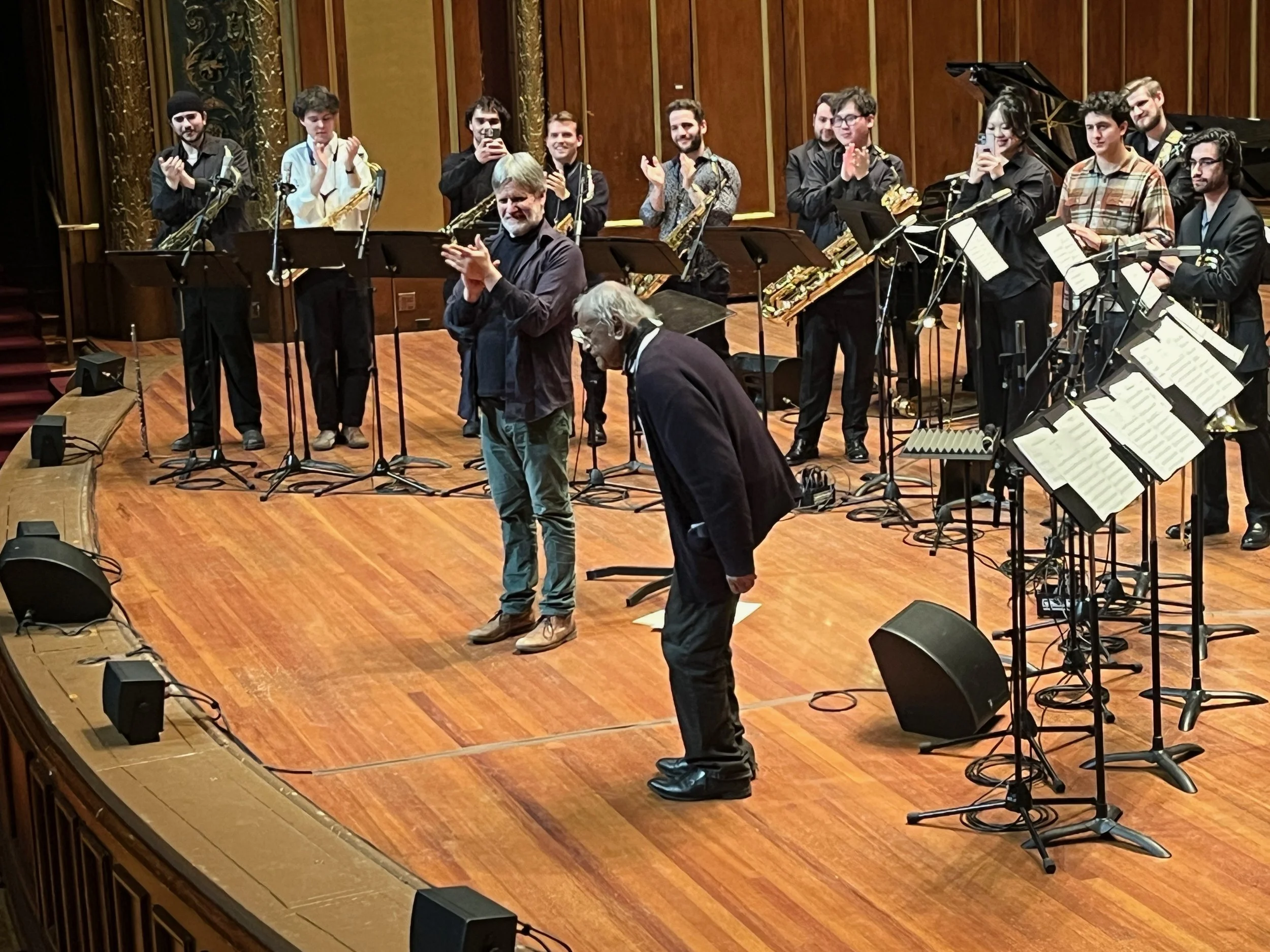
Braxton takes a bow in Jordan Hall with Frank Carlberg and the Jazz Composers Workshop Orchestra
Earl’s Kitchen (Conservatory 3D) - February, 2026
It’s a late Thursday night in Boston and I am having a drink in a slightly too fancy mall restaurant. It’s a big, corporate-feeling place, with the staff talking to each other on wireless headsets as they negotiate where to seat us. It’s surprisingly busy. It feels like we could be anywhere in the world or at least in any upscale neighborhood in North America. The neutrality of the surroundings is in stark contrast to the unique assembly of people gathered at the table and the rarity of the occasion we are celebrating. I am with three of my conservatory colleagues - Frank, Anna Webber, and Katie Drago Luellen, our Dean of Admissions - James Fei, and Anthony Braxton. The young server asks us if we’re musicians. Do we look like musicians? What else besides music could have brought this multigenerational, multiracial group of people together? There are infinite answers to that question, especially in education, but of course she is right. We have just finished a concert in Jordan Hall, the culmination of Braxton’s residency.
In 1995 I wrote that when Braxton worked on improvisation with his student ensemble he talked about “hearing each other and focusing on creating a unique sonic environment.” I left something important out of that sentence, the mind that is doing the “focusing,” the thing in the middle of that process. When musicians improvise together, we absorb input from the people and space around us, put it through the real-time filter of our minds, and output the musical material that forms that “sonic environment,” a structure the ensemble spontaneously generates through collective effort. Whoever I was in the resonant space of Jordan Hall that night, full of “friendly experiencers,” had thirty-five more years of experience with this particular human phenomenon, and yet hearing the same alto saxophone sound that propelled me through our duo concerts and our Ghost Trance work ringing out all these years later brought me right back to the subterranean room at Wesleyan and the stage at the Leipzig Gewandhaus. It was as if all the music I had worked on in the decades since then fell away, and I was once again encountering the source of it all, the beginning of what was then my future and is now my past and present, my “root guru.” As I improvised on stage with my colleagues, Fei and Braxton, with my students listening in the wings, I realized that I was right in the middle of whatever we are in time and space, whatever I am.
As we finish our late night drinks, Braxton is in a good mood, talking about releasing the recording as a box set, about the student players who impressed him, about how Boston feels “radiant” to him in ways that other places do not. It’s getting late and everyone is tired. I have a train to catch. This is going to be the end of this chapter in the long story of my entanglement with Prof. Braxton A. As I get ready to leave, he looks me in the eye and says, “We are family.”